

30 | 07 | 2026
Culture
Vuk's alphabet
How one man quarreled and literate a nation
Serbian language, script reform, Vuk Karadžić and Sava MrkaljThirty letters today seems like something that always had to be exactly that way. At the beginning of the 19th century, it was neither obvious nor harmless to propose that the literary language should be brought closer to the speech of ordinary people. Vuk Karadžić changed letters, but in doing so he opened a much bigger question: who has the right to decide how a people writes, reads, and names its own life.
His reform did not arise suddenly nor did it win in one stroke. Behind it stood the work of Sava Mrkalj, the support of Jernej Kopitar, years of polemics, and a generation of writers who proved that the folk language could carry both poetry and science. That is why the story of Vuk's alphabet is simultaneously a story about language, power, faith, and the courage to question an established rule.
The alphabet did not change only writing
When you remove unnecessary letters from the language and introduce clear signs for sounds, you get a simpler script. When you then say that literature should be written in the language people speak, you change the relationship among learned people, the church, the state, and the nation. That is why Vuk's reform was never just a spelling exercise.
One people, several ways to write the same word
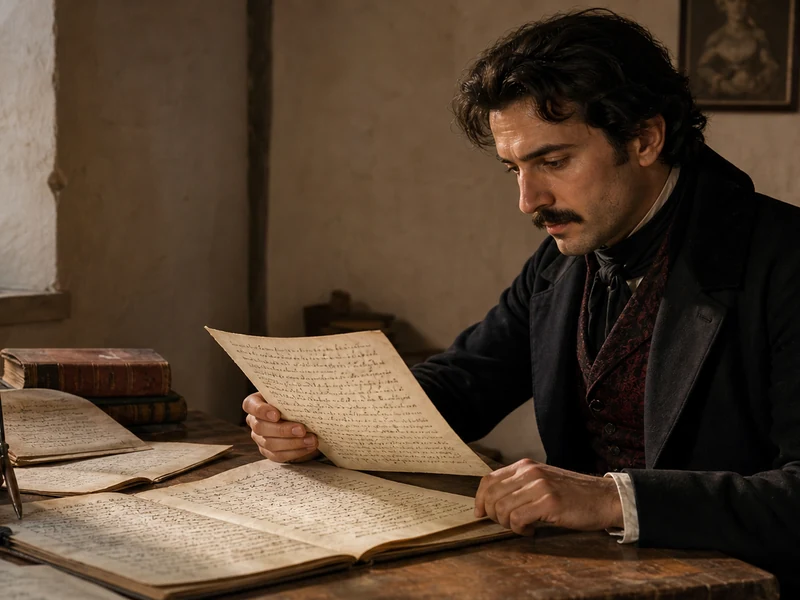 A modern visual reconstruction of work on language at the beginning of the 19th century. The image is not a documentary depiction of Vuk Karadžić.
At the beginning of the 19th century, the literary language of the Serbs was not unified. In books, Church Slavonic, Russo-Slavonic, Slavo-Serbian, and elements of folk speech were intertwined. The alphabet had more than forty signs, among them letters that did not correspond to a specific sound in the living Serbian language.
For an educated writer, this meant choosing between tradition, school habits, and one's own solutions. For a beginner, it meant having to learn reading and writing through a system where the relationship between sound and letter was not always direct.
Sava Mrkalj opened the door through which Vuk passed
The story in which Vuk sits down alone and invents a new alphabet is convenient for school memorization, but it is not historically honest. Sava Mrkalj in 1810 in the work Salo debeloga jera libo azbukoprotres carried out a comprehensive reform of Cyrillic and showed how much the script could be simplified.
Mrkalj removes the excess: starts from the sounds of the folk language and rejects signs without a clear function
Vuk accepts the basis: In 1814, he highly praises Mrkalj's work and uses his solutions.
The reform is completed: Vuk adapts the system and introduces signs needed for sounds that did not yet have a simple solution.
The alphabet enters books: The 1818 dictionary shows how the new system works on thousands of real words.
An important correction of the myth: Vuk is the most successful bearer of the reform, but he is not its only initiator. Without Mrkalj's radical simplification, the story of today's alphabet would be incomplete.
Jernej Kopitar recognized a man who knows the living speech
After the collapse of the First Serbian Uprising, Vuk goes to Vienna in 1813. There he meets Jernej Kopitar, a Slovenian philologist and censor of Slavic books. Kopitar encourages him to write down a grammar, collect folk songs, and compile a dictionary.
Vuk did not have the classical philological education that many of his opponents had. He had something else: exceptional knowledge of folk speech, experience as a scribe, and the ability to listen to how people really talk. Kopitar gave that experience direction, European connections, and professional support.
The reform succeeded when the experience of the living language, a philological plan, and printing persistence came together.
 A contemporary reconstruction of a printing workshop in Vienna. The depiction evokes the polemic, not a specific historical event.
From a complex heritage to a rule a child can check by ear
| Before the reform | Vuk's solution | Practical consequence |
|---|---|---|
| More signs than sounds in the folk language | An alphabet of 30 functional letters | Fewer signs to remember and a clearer system. |
| The same sound could be written in different ways | One sound gets one sign | Writing approaches pronunciation. |
| Literary language distant from everyday speech | Folk speech becomes the basis of the literary language | The text is more accessible to the reader and closer to the writer's living experience. |
| Words of ordinary life have low prestige | The dictionary records, interprets, and introduces them into cultural record | The language of villages, crafts, family, and customs becomes literary material. |
| The author often chooses orthographic solutions himself | A consistent phonological principle | A basis for broader standardization is created. |
The summary 'write as you speak' was not invented by Vuk. A similar phonetic principle is associated with the German grammarian Johann Christoph Adelung, and among Serbs it was consistently advocated by Mrkalj before Vuk. Vuk's greatness is that he turned the principle into a sustainable system and persistently applied it in books.
The opponents were not only defending superfluous letters
- simpler literacy
- literature understandable to a wider circle of people
- a consistent relationship between sound and letter
- preservation of folk songs, words, and customs
- more independent development of the modern Serbian language
- a break with church and literary tradition
- moving away from Russian cultural influence
- lowering literature to the speech of the uneducated
- introducing crude or indecent words into the dictionary
- weakening the authority of the church and learned circles
In the 1818 dictionary, words from everyday life that previously did not belong in a respectable book were particularly objectionable, as was the letter j taken from the Latin script. The state ban on Vuk's orthography in Serbia shows that the polemic did not remain among philologists. The question of script became a question of cultural policy.
Why 1847 is remembered as Vuk's victory
The victory of the reform did not mean that the authorities announced a new rule that morning. The year 1847 became a symbol because four important books showed that the language based on folk speech had grown capable of different types of text.
Not all the books had the same goal, but together they showed the breadth of the new literary language.
Branko Radičević, Poems
They showed that the folk language can be young, lyrical, direct, and artistically convincing.
Đura Daničić, War for the Serbian Language and Orthography
The reform received a systematic philological defense, not just Vuk's persistence.
Vuk, translation of the New Testament
The most demanding religious text became a test of the expressive power and precision of the new language.
Petar Petrović Njegoš, The Mountain Wreath
A great poetic work confirmed that a living language can carry history, philosophy, and tragedy.
Official acceptance of Vuk's orthography in Serbia came later, in 1868, four years after his death. The cultural victory, therefore, preceded the administrative one.
The most interesting Vuk is the man with collaborators, opponents, and mistakes
Vuk's reform facilitated literacy and created an exceptionally consistent writing system. His 1818 dictionary with 27,270 words is not just a language manual. It preserves data about customs, beliefs, occupations, and everyday life.
However, history should not be turned into a story about a single genius who brought light to everyone. Vuk chose one dialectal basis, relied on predecessors and collaborators, entered into sharp conflicts, and made decisions that had a real cultural cost for contemporaries. Precisely for that reason, he is more valuable as a historical figure than as a sinless icon.
Slowly pronounce any ordinary word and try to write each sound with one letter. In that simple act, the core of the reform that once caused bans and decades-long quarrels still lives today.
Vuk's life from Tršić to the great language reform
The greatest reform is the one we no longer even notice
Vuk's alphabet won so completely that today it seems natural to us. Behind that ease stand Mrkalj's boldness, Kopitar's support, Vuk's persistence, the resistance of institutions, and books that proved that the people's language is wide enough for an entire cultural life.
Which letter would you find hardest to explain to a foreigner?
Is it lj, nj, dž, đ or ć? Write how you would describe its pronunciation without the help of a recording.
Find a word that sounds the way it looks
Choose one native word you love for its sound. Say it slowly and see how precisely the letters follow the sound.
Verified sources: National Library of Serbia, Vuk Stefanović Karadžić; Digital NBS, Serbian Grammar Book, 1814; Vanja Stanišić, On Mrkalj's and Vuk's reform of Cyrillic. The photographs are contemporary visual reconstructions and do not represent documentary footage of specific historical events.



Add comment